Enter your email address below.
4 min read...
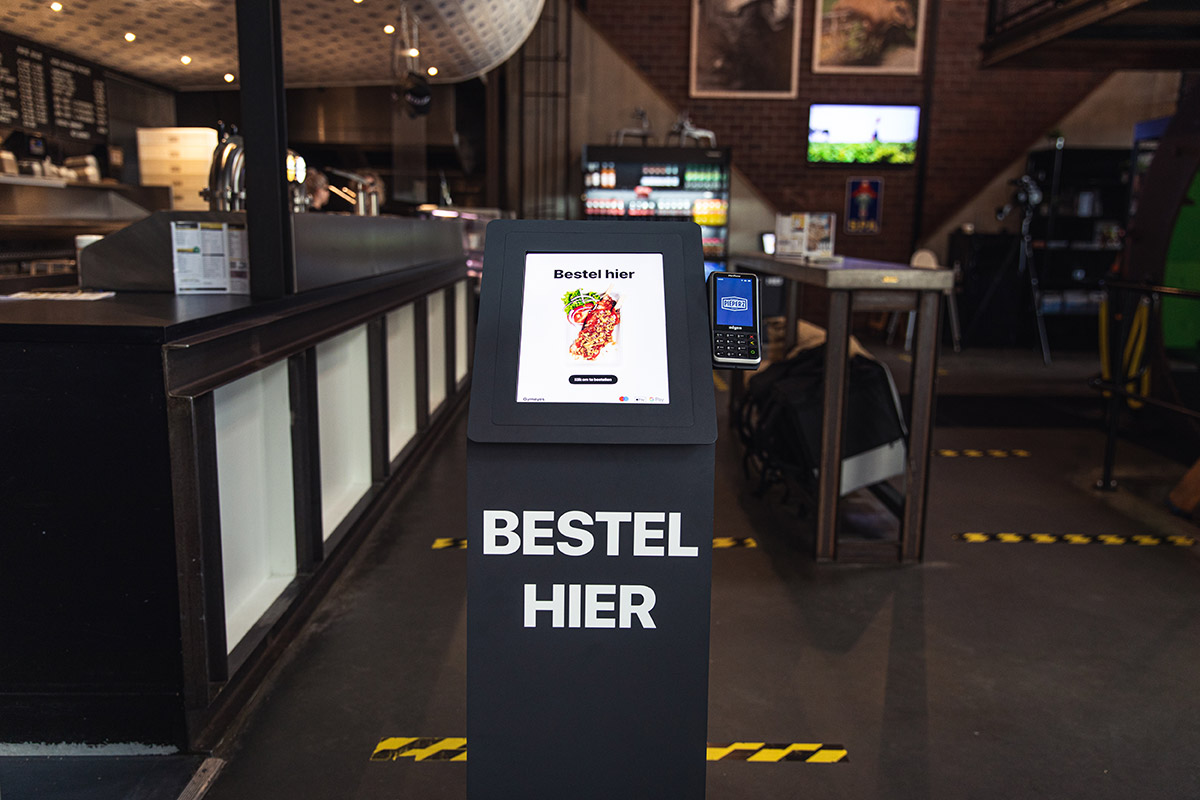
The question we often get from business owners is “what would work better, a self-order kiosk or a QR code?” The short answer is: it depends on your business and what you’re looking for. Both technologies have advantages and disadvantages. That’s why I’d like to ask you the question: what are you looking for?
In this article, we explain what benefits you most as a business owner when looking for such solutions. We provide a brief analysis of the most important considerations from entrepreneurs, for entrepreneurs.
Are you looking for speed? By that I mean speeding up the ordering process so you can reduce queues and handle more orders. In that case, I often see that a kiosk works better than a QR code. With a self-order kiosk, you create an additional sales channel that allows you to take orders faster. The reason QR codes are less suitable for this is that they often involve delivering orders to tables, which takes extra time.
Winner: Kiosk 🥇
If you want people to spend more on average per order, the choice becomes a bit more difficult. Both a QR code and a kiosk can automate upselling, leading to higher spending. However, the data from our own kiosk shows that people spend more through the kiosk compared to the QR code. My feeling is that this is because the screen is larger and people can order together. When your guests place an order on their own phone, it’s often done by one person. At a kiosk, people can look and choose together. I can’t back it up with data yet, let’s hope that’s possible soon :)
Winner: Kiosk🥇
This one’s a no-brainer — it’s obviously the QR code. The biggest advantage of the QR code is that no hardware is involved. The investment is much lower; you can get started online right away and only need to purchase a few stickers. Curious about the investment for a self-order kiosk? Here you can see it.
Do keep in mind, however, that transaction costs for a QR code are often higher than for a kiosk. I frequently come across business owners who make this mistake. Onesix works with Adyen, and on their website you can read that online payments like iDEAL are more expensive than Maestro. Is the average order value of your business lower than €5.00? Then I wouldn’t recommend a QR code — it’s simply too expensive.
Winner: QR Code 🥇
Due to the coronavirus, we’ve experienced first-hand that you always need to stay flexible. During a (partial) lockdown, you don’t want to be stuck with expensive long-term contracts. Our products are always cancellable on a monthly basis, but if you order a kiosk or QR code elsewhere, make sure you can always cancel. We see in the industry that a kiosk often comes with long contracts, while this is easier with a QR code.
Winner: QR Code 🥇
Saving on staff costs is a tricky one in my opinion. I often see that a kiosk leads to more orders and therefore more activity in the kitchen. Additionally, a QR code is often accompanied by more frequent table service. In short: there’s no clear winner. Both options can lead to savings on staff, but honestly, I don’t see it happen often, sorry 😉
Winner: Both
Covid-19 has changed our world, so your guests are more cautious when it comes to hygiene. A kiosk that is touched by multiple people is naturally less hygienic than your own phone. This is therefore a clear win for the QR code.
Winner: QR Code 🥇
Did you scroll straight down to read the conclusion? I do that often too 😉. The conclusion is that a kiosk is often chosen for speed or higher spending per customer. The QR code works better in hospitality venues where table service is provided. One of the biggest advantages of the QR code is that it requires a lower investment and responds better to the post-Covid-19 world.
Would you like to try the kiosk or QR code for free in your business? You saw it coming — you can do so via this page. Don’t hesitate to call us for a (digital) cup of coffee either 👌

Mitchell is the founder of Onesix. This news site offers relevant articles for people working in or interested in hospitality, retail and amusement parks.