Enter your email address below.
5 min read...
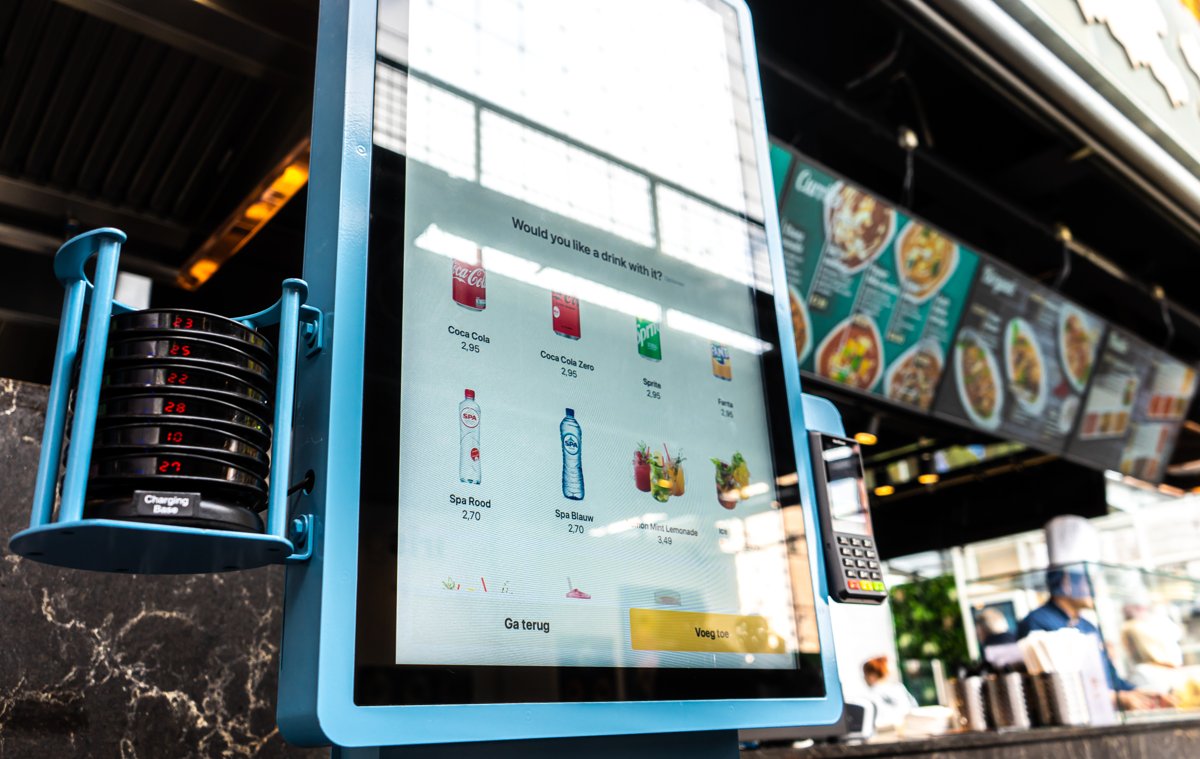
A multilingual self-order kiosk might be the most underrated revenue lever for businesses in tourist areas. You know the scene: a German family at the counter, pointing at the menu, your staff member making the best of it in improvised English, and a queue that keeps growing behind them. Everyone’s trying their best, and you’re still losing orders. In this article you’ll read what the language barrier really costs you, and how a kiosk that speaks multiple languages fixes it.
Simple: your guests come from everywhere, but your menu and your counter usually speak one or two languages. Every guest who doesn’t fully understand the menu orders cautiously. The classic “just a coke and fries” is rarely the order someone actually wanted. It’s the order they dared to place.
A multilingual self-order kiosk flips that around. Guests pick their own language, see the full menu, understand what’s in each dish and order with confidence. No guessing, no embarrassment, no translation work for your team.
The Kiosk displays multiple languages when you enable them for your location. You decide what fits your crowd: a beach pavilion full of international visitors makes different choices than a lunchroom in a residential area.
Guests choose the language they understand and browse the menu at their own pace. Look around calmly, customise, pay. Ordering independently also means daring to choose. And guests who understand what’s on offer say yes to that extra item more often. Millions of orders prove an average of +20% revenue through smart upselling.
Nobody has to play interpreter at the counter anymore. Your staff prepares orders, helps the guests who need it and keeps the place running, while the Kiosk handles ordering in the languages you’ve set up.
Wherever international guests show up, multilingual ordering pays off. Think beach pavilions and coastal spots, fast food and lunch places in city centres, businesses near attractions and stations, and amusement parks welcoming families from all over Europe. The bigger the share of guests who don’t read the local language, the bigger the win of a menu in their own.
You don’t have to take our word for it: you test the Kiosk free for 30 days in your own business, in the middle of your season, with your guests. Not happy? We’ll simply pick it up again. The licence can be cancelled monthly, and updates and 24/7 support are part of the service. More than 1,000 hospitality businesses went before you.
The Kiosk supports multiple languages, and you set which ones are active for your location. Which languages will earn the most for your business is something we’ll look at together during the trial.
No, rather less. Guests pick their language, order and pay at the Kiosk. Your team no longer has to translate at the counter and gets time back for the guests themselves.
Especially then. The moments when the language barrier costs you most are exactly when the queue is longest. Guests ordering independently in their own language keep things flowing.
Yes. At Onesix you test the Kiosk free for 30 days, no strings attached, including the languages you set up. So you see what it does in your own business.
Tourists are happy to order from you. They just want to understand what they’re ordering. A multilingual self-order kiosk removes exactly that barrier: guests choose with confidence, your queue keeps moving and your offers finally reach everyone.
Start your free trial via the Kiosk page, or get in touch. We’ll work out together which languages your guests need.
Wouter works as a Marketing Specialist at Onesix. This news site offers relevant articles for people working in or interested in hospitality, retail, and amusement parks.